
The World Your Brain Invented
On assumptions, neural architecture, and the quiet tyranny of what we think we know

Right now, as you read these words, your brain is lying to you.
Not maliciously. Not even consciously. It is simply doing what brains do: filling in the gaps, smoothing over the uncertainty, handing you a version of reality that is faster, cheaper, and more confident than reality actually warrants. Neuroscientists call this predictive processing. Your brain does not passively receive the world — it predicts it, moment by moment, and only updates when something surprising breaks through.
This is not a flaw. It is an evolutionary marvel. A brain that had to process every photon, every sound wave, every social nuance from scratch would be too slow to survive. So your nervous system builds models — compressed, assumption-laden maps of how the world works — and runs on those maps instead of the territory itself.
The trouble is: we forget that maps are not territory.
How the Brain Builds Its World
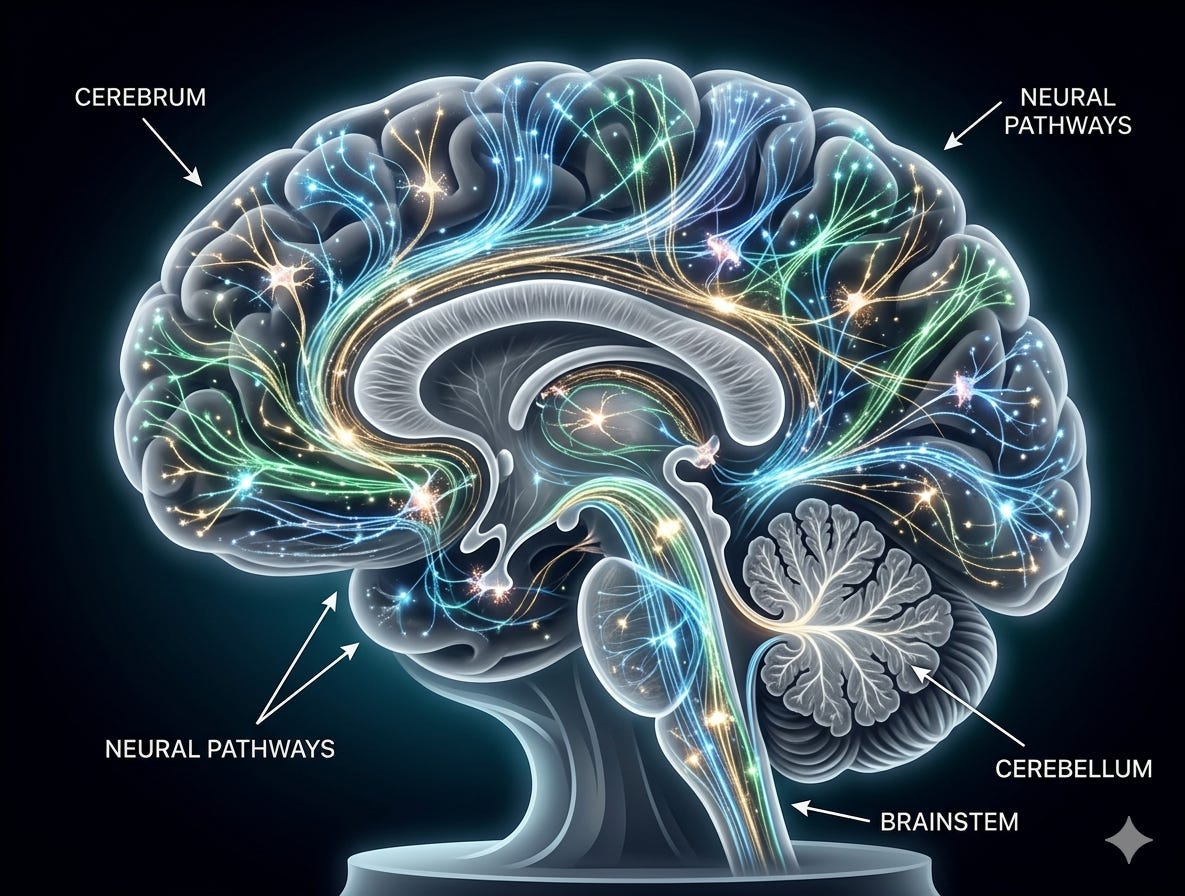
Every experience you have ever had has carved neural pathways — literal physical grooves in your nervous system. Neurons that fire together wire together. Repeat an experience enough, and the pathway deepens, until the brain begins to take that path automatically, almost before conscious thought can intervene.
This is why a childhood in which love was conditional quietly teaches the nervous system that love is conditional — and why that person, decades later, flinches at intimacy before they know why. The assumption is not a thought. It is a groove. It runs beneath thought.
Your worldview, then, is not a philosophy you chose. It is the accumulated sedimentation of every significant experience, every repeated pattern, every moment of fear or wonder or shame or delight — all of it compressed into a predictive model your brain runs silently in the background, shaping what you notice, what you ignore, what you expect, and therefore, in many ways, what you get.
DNA and the Assumptions You Were Born With
It goes deeper still. Before circumstance had a chance to shape you, genetics had already laid the groundwork. Your temperament, your sensitivity to threat or novelty, your baseline levels of cortisol and dopamine, your predisposition toward anxiety or equanimity — all of this was written into you before your first breath.
You did not choose your nervous system’s starting settings. You inherited them — from parents who inherited them from their parents — each generation passing forward not only genes but, through epigenetic mechanisms, the biochemical echoes of their fears, their hungers, their traumas, their longings.
So when you make an assumption about whether the world is safe or dangerous, abundant or scarce, welcoming or threatening, you are not simply drawing on your own experience. You are drawing on a library that is older than you are.
What Quantum Physics Quietly Suggests
Here the story gets stranger, and more liberating.
Classical physics gave us a picture of a fixed, objective world waiting to be observed. Quantum physics dismantled that picture. At the most fundamental level of reality, what we call a “particle” does not have a definite position, spin, or state until it is measured. The act of observation collapses possibility into actuality.
This is not merely a laboratory curiosity. It points toward something philosophically radical: that what we bring to the encounter with reality — our instruments of perception, our frameworks of meaning — participates in determining what we find. The physicist and the phenomenon are not cleanly separable.
Now, the quantum world and the human-scale world are different domains, and we should be careful not to overextend the metaphor. But the principle resonates: our assumptions are not neutral windows. They are active participants. They select, highlight, filter, and suppress. They make certain futures more probable by priming us to see and act in ways that call those futures into being.
This is the self-fulfilling prophecy written in the language of physics and neuroscience both: the map shapes the territory it purports only to describe.
How We Shape Each Other
And this is where it gets uncomfortably powerful.
Your assumptions do not only shape your private inner world. They shape the people around you.
In psychology, the Pygmalion effect demonstrates that the expectations teachers hold of students measurably alter student performance — not through any direct instruction, but through thousands of tiny behavioral signals: the warmth of a glance, the patience in a pause, the implicit message of I believe you can. The student’s nervous system reads these signals and responds, confirming the prediction.
This means that when you walk into a room carrying an assumption about the people there — that they are capable or incapable, trustworthy or suspect, worthy of your openness or deserving of your walls — you are not only perceiving them. You are, in some real and measurable sense, participating in creating the version of them you will encounter.
Our assumptions about human nature ripple outward into institutions, policies, cultures, civilizations. A society that assumes human beings are fundamentally selfish builds systems that enforce and reward selfishness, and then points to the result as proof of the original assumption. The loop closes. The prophecy fulfills itself at civilizational scale.
The Liberation That Awareness Offers
None of this is destiny. This is the crucial turn.
Neural pathways, however deep, are not permanent. The brain retains plasticity — the capacity to rewire — throughout life. New experiences, new practices, new ways of attending can carve new grooves. The old paths do not disappear overnight, but they can be starved of repetition while new ones are fed.
The first and most essential step is awareness.
Not the awareness that judges and battles the old assumptions — that only reinforces them by pouring attention and energy into the very grooves we are trying to leave. But the quieter awareness that notices: this is a pattern, not a truth. This is a map, not the territory. This response is older than this moment. This is my nervous system speaking, not reality.
That space of noticing — however brief, however incomplete — is the beginning of freedom.
When you recognize that your assumption is not the world but a story about the world, constructed from DNA and circumstance and the predictive machinery of a brain trying to survive, something loosens. The assumption loses its invisibility, and with invisibility, its power.
You cannot simply decide to see differently. But you can become curious about how you are seeing. And curiosity — genuine, patient, non-defensive curiosity about your own perceiving — is how new neural pathways are born.
The world you live in is, to a stunning degree, the world your assumptions have assembled. So is the world of everyone you touch.
This is not cause for despair. It is cause for extraordinary care — and extraordinary hope.
Because if we helped build this world through what we have believed without knowing we were believing it, then becoming conscious of our believing is one of the most consequential things a human being can do.
Not just for themselves. For everyone the ripples reach.
Stan is a writer exploring consciousness, human nature, and the conditions for collective flourishing.